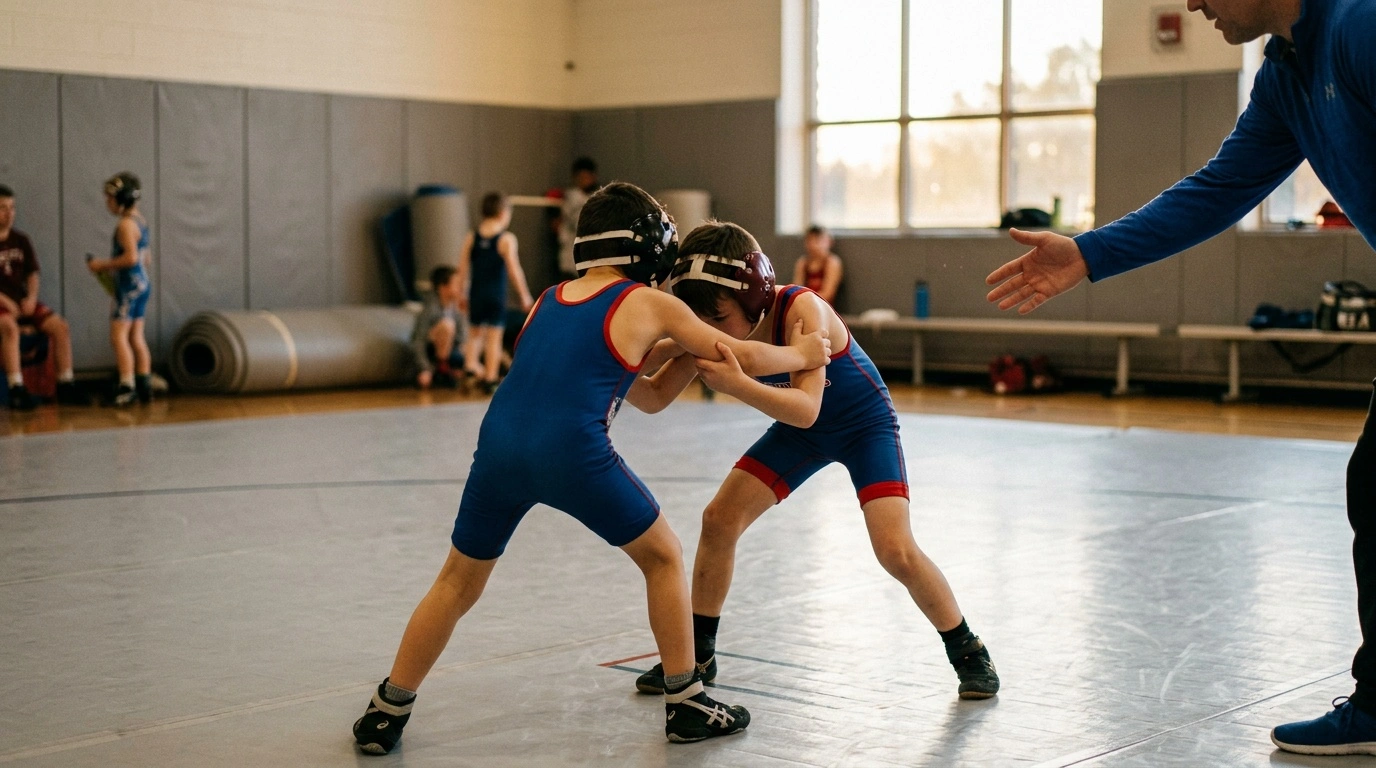
Youth wrestling coaching tips work best when coaches put safety, simple technique, and steady development ahead of winning. Build each practice around one clear objective. Then teach the skill in small pieces and provide enough supervised repetitions to make the movement familiar.
Young athletes need an active room, but activity without a teaching plan quickly becomes noise. Coaches must also manage confidence, behavior, and physical contact in age-appropriate ways. Pair wrestlers thoughtfully, correct mistakes without embarrassment, and treat competition as a test of current skills.
Youth Wrestling Coaching Tips Start With the Right Definition of Success
For beginners, success means learning how to stand, move, fall, defend, and work through difficult positions. Wins and losses matter to children, but they should not become the main measure of progress. A wrestler may improve by holding a sound stance for an entire match, regardless of the score.
Set a few observable goals for each stage of the season. Examples include returning to stance after an attack, completing a safe penetration step, or escaping without exposing the back. Share those goals so wrestlers know what coaches will watch.
Praise decisions and effort with specific language. Instead of calling every performance “great,” identify an action the athlete can repeat. For example, say, “You kept your head up and circled instead of backing straight away.”
Plan Each Youth Wrestling Practice in Advance
A youth practice needs a clear beginning, middle, and end. Keep transitions short so wrestlers spend little time standing in line. Start with wrestling movements such as stance motion, level changes, hip-heists, sprawls, rolls, and controlled partner work.
Next, briefly review a familiar skill before introducing the day’s main technique. Keep instruction short and move quickly into partner practice. Children often understand balance and pressure better when they can feel the position.
Add resistance in stages. Begin with no resistance, move to a predictable reaction, and finish with a short live situation. End with a calm recap so wrestlers can explain what they learned.
A practical youth wrestling practice plan can follow this order:
- Movement warm-up: Use stance, motion, tumbling, and controlled body-position drills.
- Review: Revisit one skill from the previous practice.
- New instruction: Teach one main action and no more than one common follow-up.
- Cooperative repetitions: Let partners learn the movement’s shape and sequence.
- Progressive resistance: Give the defensive wrestler a specific, limited response.
- Situational wrestling: Start each exchange from the position taught that day.
- Recap and cool-down: Reinforce one or two points and preview the next practice.
Teach Position Before Adding More Moves
Young wrestlers do not need many takedowns if they cannot hold a balanced stance. Teach bent knees, controlled hips, a raised head, tucked elbows, and evenly distributed weight. The athlete should remain ready to move in any direction.
Check each wrestler’s stance during motion. Many beginners look solid while stationary but stand upright as soon as they step. Use simple cues such as “head up,” “hands home,” and “short steps.”
Give only one correction at a time. Practice circling, changing direction, controlling distance, and recovering stance after contact. Teach level changes early because bending from the waist weakens balance and exposes the head.
Attacks and defense become easier when wrestlers move without crossing their feet or clicking their heels together. Build that movement foundation before expanding the technical system.
Build a Small System From Neutral, Top, and Bottom
A useful beginner system gives each wrestler one dependable option from every major position. From neutral, teach an age-appropriate takedown that current rules allow. Add a simple finish for a common defensive reaction.
On top, teach wrestlers to establish control before attempting a breakdown or turn. From bottom, begin with a sound base, hand control, and a reliable stand-up or escape.
Connect each technique to the next position. A completed takedown should flow into control rather than create a pause. Explain where the head, hands, hips, and knees belong.
Demonstrate the technique once at normal speed and again slowly. Show only the details needed for that day’s objective. Too many details can distract beginners from the movement’s main purpose.
Check current league or governing-body rules before teaching lifts, throws, locks, or potentially dangerous positions. Rules may differ by age group and competition format.
Use Progressive Resistance Instead of Endless Drilling
Cooperative drilling helps athletes learn a technique’s path. However, it can create false confidence when the partner never reacts. Once wrestlers can perform the movement safely, introduce one predictable response.
The partner might block with a hand, sprawl lightly, or maintain a firm base. The attacking wrestler then learns to recognize pressure instead of performing choreography.
Increase resistance only when both partners maintain sound position and emotional control. Short situational rounds help wrestlers solve the same problem repeatedly. They do not need to wait for that position to appear during a full match.
For example, start one wrestler halfway through a stand-up while the partner holds control. Reset after an escape, return, or loss of position. This format creates useful repetitions and helps coaches stop unsafe habits early.
Pair Youth Wrestlers by More Than Age
Body size matters, but effective pairings also account for strength, experience, speed, temperament, and contact control. Two wrestlers of similar weight may still make poor partners. An experienced competitor can overwhelm a child attending a first practice.
A skilled athlete can work safely with a beginner when the assignment is clear. The experienced wrestler must help the partner learn rather than dominate the exchange.
Rotate partners when a change will improve learning. However, give anxious beginners enough continuity to become comfortable. Watch every pairing closely during live work, especially when fatigue or frustration affects body position.
Stop mismatches instead of telling a struggling child to toughen up. Offer another partner when an athlete feels uncomfortable. Do not require the child to explain personal concerns in front of the group.
Give Short, Specific Coaching Feedback
Children rarely process a speech while breathing hard or holding a difficult position. Stop the action, make one correction, and let the wrestler try again. Describe an action the athlete can perform instead of simply naming the mistake.
“Keep your elbow against your ribs” provides more direction than “Don’t get loose.” Likewise, “Circle toward the ankle” gives clearer guidance than “Move faster.”
Ask occasional questions to build awareness. For example, ask, “Where did you feel your balance go?” Questions like this help athletes become independent problem-solvers.
Do not interrupt every repetition. Wrestlers need uninterrupted attempts to develop timing and confidence. Stop the whole room only when several athletes make the same error.
Make Wrestling Games Serve a Purpose
Games can engage younger athletes while teaching balance, pressure, reactions, or mat awareness. Knee-tag games reinforce stance and distance. Controlled sumo-style circles teach athletes to create and resist pressure without wrestling a full match.
Grip and hand-fighting games can also build confidence with contact. Define the rules, boundaries, and intensity before starting. Explain the skill behind each game so athletes understand its place in practice.
Avoid elimination formats that leave less-skilled children sitting out. Effective games give every wrestler repeated chances to act, fail, adjust, and restart. Change any game that produces collisions, uncontrolled throws, or escalating arguments.
Put Safety and Athlete Welfare First
Coaches should maintain all training required by their club, school, governing organization, and local law. Requirements may include first aid, concussion response, background screening, and athlete-protection education. Treat these requirements as daily operating standards rather than paperwork.
In the United States, coaches within the Olympic and Paralympic movement may also have SafeSport obligations. Follow organizational policies for communication, transportation, and interactions with minors. Keep those interactions observable and interruptible.
Inspect the practice area before athletes step onto the mat. Look for exposed hardware, mat gaps, wet areas, and nearby obstacles. Clean mats according to the facility’s approved procedures.
Require clean practice clothing and remind athletes to wash their gear after every use. Wrestlers with suspicious skin lesions should follow the applicable medical and competition-clearance process before returning. Coaches should not diagnose skin conditions from the edge of the mat.
Require trimmed fingernails, prohibit jewelry, and schedule regular water breaks. Never use exercise as punishment for reporting pain.
Remove any wrestler with possible concussion signs or symptoms from activity immediately. Do not allow a same-day return. Follow local law and organizational policy for evaluation, medical clearance, and a gradual return to wrestling.
Seek prompt medical attention for neck pain, loss of consciousness, breathing difficulty, severe joint pain, or an obvious deformity. Do not attempt to “work out” a potentially serious injury.
Avoid Weight-Cutting Culture in Youth Programs
Never encourage children to dehydrate, skip meals, wear excessive clothing, or use saunas to reach a lower weight class. These practices interfere with training and create immediate health risks for growing athletes.
Discuss food as fuel for practice, recovery, and normal development. Avoid dividing foods into moral categories such as “good” and “bad.” Coaches should not prescribe diets to children.
Direct questions about body weight, nutrition, or growth to a qualified healthcare professional. Follow the relevant organization’s weight-management and weigh-in rules. However, passing a formal assessment does not make aggressive weight loss appropriate.
Place wrestlers in classes where they can compete safely without a frantic attempt to change their bodies. Long-term development matters more than reaching the lightest possible class.
Prepare Wrestlers for Competition Without Adding Pressure
Before a competition, teach wrestlers the event routine. Cover check-in, warm-ups, mat assignments, reporting procedures, handshakes, and post-bout check-ins with the coach. Familiar routines reduce avoidable stress.
Give each athlete one or two match goals within personal control. A wrestler might take the first purposeful attack or build a base immediately from bottom. Avoid detailed tactical scripts that collapse when an opponent reacts differently.
During the match, use brief cues that the wrestler already knows from practice. Afterward, allow emotions to settle before discussing technique. Ask what the athlete noticed, identify one successful action, and select one priority for the next practice.
Do not conduct a public postmortem in the stands. Avoid blaming officials or letting the result control the ride home.
Work With Parents as Part of the Program
Parents can support the program more effectively when coaches explain expectations before the season gets busy. Provide guidance about attendance, equipment, hygiene, schedules, communication, and sideline behavior. Explain how families should raise concerns.
Clarify which instructions come from the coach during matches. Encourage parents to praise effort, courage, and sportsmanship instead of shouting conflicting technical commands.
Address concerns privately and listen before defending a decision. This matters most when the issue involves safety, pairing, bullying, or a child’s comfort. Base performance discussions on observable behavior rather than labels such as lazy, soft, or naturally gifted.
Consistent communication between coaches and families lets the wrestler focus on learning. The child should not need to manage competing adult expectations.
Troubleshoot Common Youth Wrestling Problems
Problem: Wrestlers perform a move during drilling but cannot use it live. Practice may have moved directly from no resistance to unrestricted wrestling. Add progressive resistance and short rounds that begin in the position taught that day.
Problem: Practice becomes chaotic during instruction. The demonstration may include too many details or last too long. Gather athletes where everyone can see, teach fewer points, check understanding, and restart activity quickly.
Problem: One child avoids live wrestling. Fear, pain, embarrassment, poor pairing, or limited preparation may cause the hesitation. Speak with the athlete privately and check for health or safeguarding concerns.
Rebuild confidence through controlled situations with a trusted partner. Do not force the child into immediate full-speed competition.
Problem: Stronger wrestlers rely on force. They may win practice exchanges without using sound position. Add constraints, such as scoring only with the day’s technique, and choose partners who can challenge them safely.
Problem: The team fades late in matches. Conditioning may contribute, but poor stance and inefficient movement also waste energy. Breath-holding and panic can make the problem worse.
Improve technical efficiency first. Then use wrestling-specific rounds with planned work and recovery instead of punishment runs.
Build Wrestlers Who Want to Keep Learning
Strong youth programs demand attention and effort without demeaning athletes. Coaches should expect hygiene, safe contact, and respect while recognizing that children learn at different speeds. Keep the technical system small enough to remember and flexible enough for different bodies.
Review each practice by asking what athletes learned, not what the staff demonstrated. Adjust when a drill proves too complex, a pairing becomes unproductive, or the room cannot support safe live wrestling.
Over time, effective youth wrestling coaching tips become daily habits. Teach position first, add resistance carefully, give useful feedback, and protect the athlete in every decision. Wrestlers who feel safe enough to make mistakes and challenged enough to improve have a reason to return.